I lead design for the Commerce domain at Cimpress, with end-to-end ownership of our B2B order-management platform.
Open to Lead, Principal and Head of Design roles · Remote or in person- $1M+
- saved a year on refunds Recare · reported by the business units
- −48%
- handling time on “Where is my order?” WISMO · CSAT up from 32% to ~70%
- ~$500K
- one-time saving across businesses Four platforms merged into one
- 3
- senior designers hired Mentored 5 designers
Four platforms merged into one in a year, with a one-time saving of about $500K across businesses.
Every core function in one place, with the right information surfaced for care and sales agents. Quotes convert, tickets close and orders get fixed in about half the time.
Working prototypeClick anything inside it, as an agent would, or pick Fix, Track, Know or Sell to jump to that part of the platform. All data is made up.Open full screen ↗
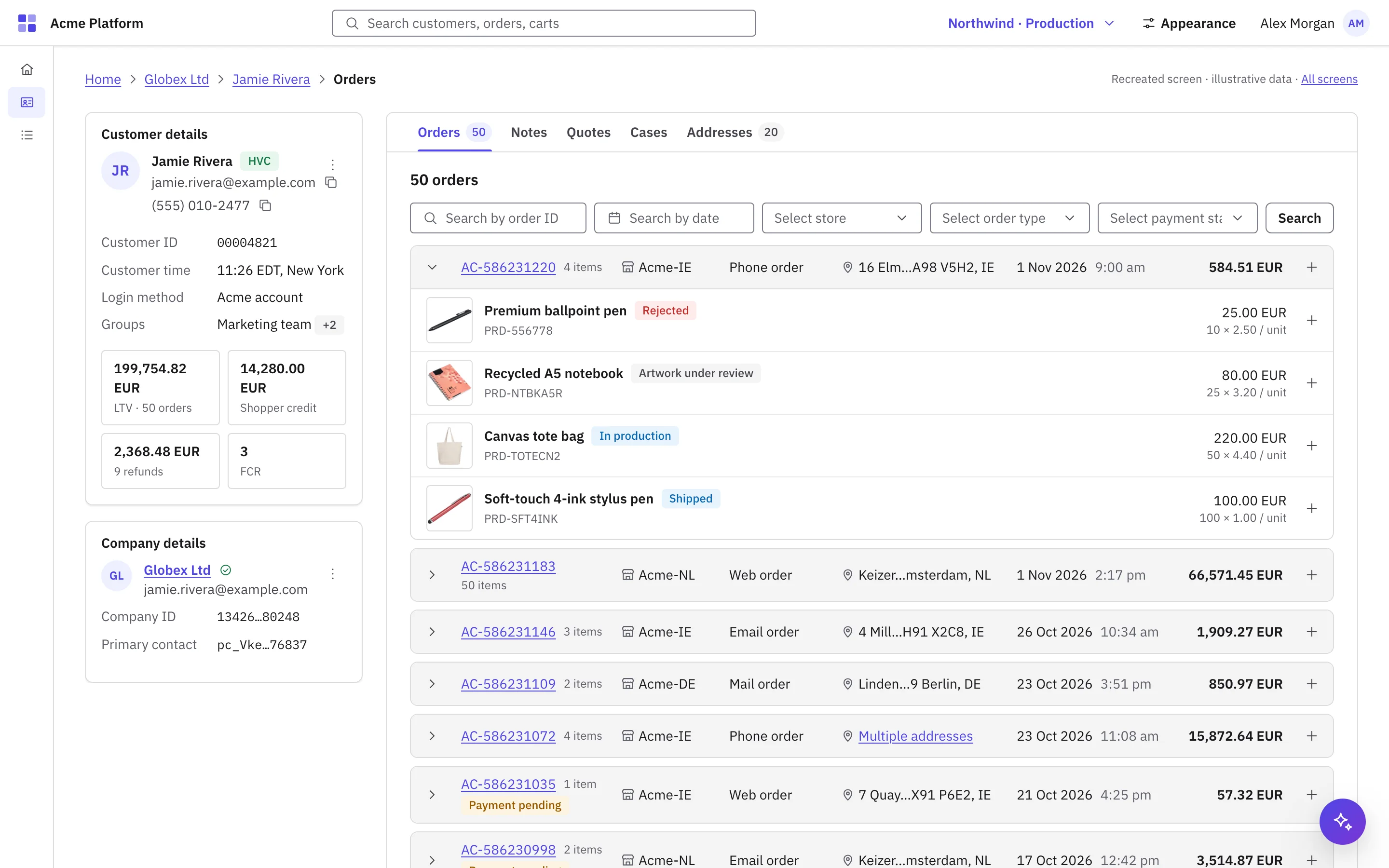
The live prototype works best on a laptop or larger screen.
Winning a customer takes months. Deleting one took a script. We changed that.
Nobody checked a request before the customer was deleted. I led this without a product manager and made accuracy, not speed, the goal.
Why it needed an ownerThe problem
Every two weeks, business unit reps sent any “forget me” requests to support on Slack as a spreadsheet. Support ran a batch script over the list of emails. Each side assumed the other had checked the requests.
How we got there
We talked to the business units raising the requests and to the support team running them. Support told us they ran the scripts without checks of their own. That one finding shaped the whole project.
What it changed
Erasure went from a manual process to a highly automated one, and ownership went back where it belonged: the privacy officers each business appoints. Support stopped being the executioner and went back to its own role, picking up only the requests that get stuck.
The mandate
The business units asked for it, and so did the commerce domain, which was reviewing every change request workflow it ran. GDPR was the biggest of them: erasing a customer directly affects revenue.
The bet
Add healthy friction. A deleted customer is gone for good, and acquiring one again costs far more than a few days' wait. Deletion should never be fast; it should be right.
How we aligned
I worked it through with the business unit reps, their customer management teams, our support team and our developers. The biggest pushback came from our own devs, who preferred the batch script to a UI. My case: the script checked nothing (stale or mistaken requests, cancellations, open orders), so its speed was creating a mess downstream.
The outcome
Ownership moved back to the business units, where it belonged. They welcomed the control: each sets its own hold period and adds its own fraud rules on top of the GDPR baseline. Support was glad to hand it over and get back to Recare, failed orders and fraud investigations.
What I'd do differently
The first release still made officers check identity and push each request along by hand, and cancelling meant asking support on Slack. The prototype shows the next step: identity confirmed when the customer asks, checks automated, and people only step in when fraud is suspected.
Working prototypeClick anything inside it, as a privacy officer would, or pick Own, Check, Hold or Track to jump to that step. All data is made up.Open full screen ↗
Investing, made simpler for everyone.
A redesign of trading, holdings and learning, for people new to investing and people who trade every day.
Working prototypePick a flow on the left, or tap through the phone like the real app. Prices are real NSE closing prices; trades are for practice.Open full screen ↗
Just another stock app, built for experts. Too much on every screen, key details hidden under dropdowns, and beginners felt lost.
Research grouped users into four types: new to investing, occasional, long term and day trader. Speed and insight mattered to all of them, so sign-up asks which one you are and tailors the app.
Daily, not live. Free live feeds are unofficial and break, so the prototype uses official closing prices.
Practice trades. Real orders need a SEBI-registered broker and KYC, so trading stays in practice mode.
One score instead of ten indicators
A Crest score from 0 to 100 sits next to the price with a one-line reading, because beginners couldn't read technical indicators.
See the trade-off before you trade
Insights show the likely outcome of buying or selling, using what you already own: consequences, not raw data.
An order form that hides what you don't need
Common choices up front, advanced options behind one switch, and the total cost always above the button.
Portfolios and watchlists, managed together
Both are lists of stocks, so they live in Holdings and behave the same way, with multi-select to move, compare or remove.
News you can read, or listen to
Every story opens with a two-line summary or a short voice version, and stocks in the story link straight to their pages.
A small team, one way of working.
A team of 4 at Cimpress Commerce, working directly with the people who own the business.
Prototypes, not specs. We build them with AI on our design system, at far higher fidelity than static Figma screens. Less time assembling screens means more time finding the right solution.
Min–max is a mindset I brought to product and design: on a shared platform, design each workflow for both the business with the least to show and the one with the most. It moved our MVPs off the happy path, so we weigh more cases and ripple effects before committing.
Hired 3 senior designers, mentored 5. I look for curious, humble people who take ownership, work independently and keep learning.
Every two weeks, a UX showcase puts our problems and planned improvements in front of a wider group for early feedback. It often sparks ideas for what an API could do, shaping product and engineering strategy.
Bring me the messy version
I'd rather see rough thinking early than polished work too late.
Make it tangible
Prototype, test, learn. I use AI and code to make ideas real before we overthink them.
Think beyond the screen
Look for patterns, systems and solutions that scale across businesses.
Day to day: find the real problem, draft UI within the week, stay with engineering until launch.
Prototypes, not specs.
Prototyping in AI tools like Claude and VS Code has made discovery fast. When building is no longer the slow part, we can afford to explore every edge case, zero state and error before anything ships. A prototype is made to be thrown away, so nobody is afraid of spending time on the wrong idea. The team goes faster and deeper, and the final solution is better for it.
The same approach, on my own work.
I rebuilt a 2021 mobile redesign as a working app, with real NSE closing prices and practice trades. It took the ideas from slides to something you can use.
What I think about design.
Agent tools are a cost lever, not a back office
Every minute an agent saves is money the business keeps. Design is how you find those minutes.
[Essay to write]Prototypes over specs
How a design system and AI changed the way my team hands work to engineering.
[Essay to write]Design debt is business risk
Why fixing what's already shipped deserves a place on the roadmap.
[Essay to write][Quote from your product director]
[Quote from the general manager]
[Quote from an engineering lead or a designer you hired]
- DronaHQUI Designer · 2015–2017
- TrepupProduct Designer · 2018–2020
- Freight TigerSenior Product Designer · 2021–2022
- CimpressLead UX Designer · 2022–now